
The short answer
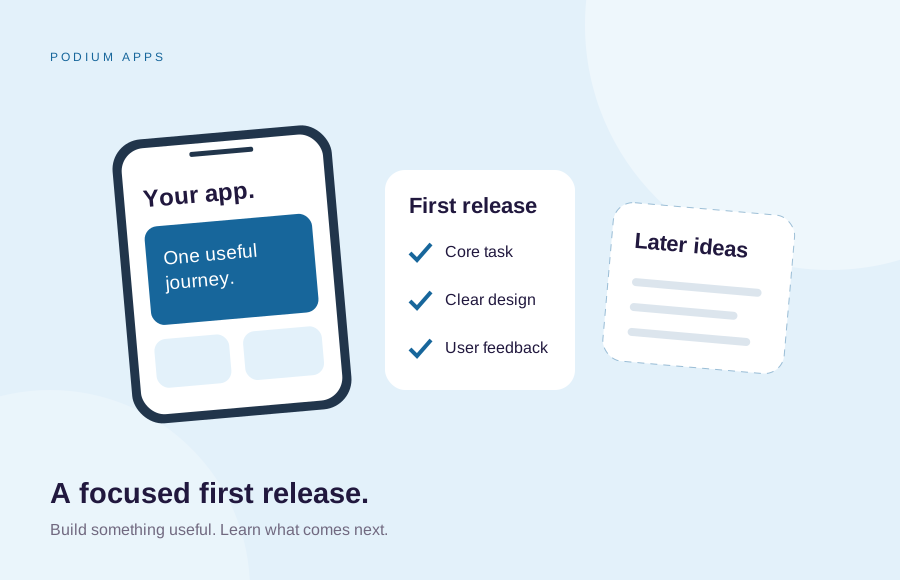
A minimum viable product, or MVP, is a first working version of an app built to test a clear idea with its intended users. It should complete a useful journey reliably and provide evidence for the next decision. Keep optional features for later, but include the access, security, accessibility and support the first release needs.
What to take from this guide
- Choose one audience and the useful task the first release must complete.
- Use a prototype to explore uncertain ideas before committing to production development.
- Plan how you will learn from users and support the app after release.
1. Start with the question your first release should answer
An early app idea often contains several products at once: a community, a booking system, a marketplace and a content library. Before choosing features, write down the primary user and the job they need to complete. Explain why they would use this app rather than their existing approach.
For a founder or business in Belfast and Northern Ireland, the useful first conversation is about that audience and purpose, not a prescribed technology. Podium Apps develops mobile apps, web applications and digital platforms across industries. The first release can be focused without making the long-term idea small.
2. Separate a prototype from a working product
A prototype helps explore a design or an uncertain interaction. It may be a sketch or a clickable set of screens and need not hold real accounts or process live payments. Use it to observe whether intended users understand the journey before committing to a production build.
A working MVP has different responsibilities. If it accepts real users or information, the team must plan access, data handling, errors and support. Government Digital Service guidance uses prototypes to explore ideas before production development; that is a useful design principle here, not a suggestion that a commercial app must follow a government delivery process.
3. Choose a complete journey, not a collection of half-built features
Write the main journey from beginning to end, including what happens when something goes wrong. A small learning app, for example, might let a learner sign in, find a relevant lesson, complete it and return later. That is an illustrative scope, not a published Podium project. Social feeds and advanced recommendations could be later decisions.
Use a scope table to separate essential behaviour from ideas that depend on evidence. “Later” should not become a hiding place for work the first release actually needs to function. Account recovery and a clear failure message may matter more at launch than an extra visual feature.
| Decision | Illustrative learning-app first release | Possible later release |
|---|---|---|
| Core task | Find and complete a lesson | Personalised recommendations |
| Returning user | Resume agreed progress | Learning streaks or community features |
| Administration | Maintain the initial content and handle support | Advanced publishing workflows |
| Evidence | Observe completion and ask about barriers | Broader reporting after usage is understood |
4. Pick the platform around where the app will be used
A phone audience does not automatically mean the first release needs separate native apps for every store. A browser-based application may suit some journeys; device features or offline requirements may point towards a mobile application. Discuss the trade-offs against the actual experience and release requirements.
Our mobile app or web portal guide explores this choice. If an integration is essential, confirm that access and a workable approach exist before relying on it in the launch plan. Keep third-party subscriptions, account ownership and provider limitations visible in the scope.
5. Budget for the release, not just the screens
Ask a supplier to separate design, development, testing, launch and ongoing responsibilities. An attractive prototype does not include every production requirement. Hosting, payment services, app-store accounts and support arrangements may create separate costs depending on the chosen approach.
There is no honest universal MVP price or delivery date without a scope. Agree which journeys are included, how acceptance will be checked and what would change the estimate. Include a route for feedback and fault reports. Our hosting and support service can form part of that discussion where it fits the application.
6. Decide what evidence will shape the next release
Before launch, agree what you want to observe: can users finish the core task, where do they stop and what do they ask for help with? Combine appropriate usage measurement with direct conversations. A download or registration shows a different thing from a person repeatedly completing the useful task.
Choose a review point that reflects the audience and likely usage, rather than promising a fixed result after an arbitrary number of days. Decide whether to improve the journey, add a feature or rethink an assumption. Bring your first-release outline to a Podium Apps project conversation; the aim is a clear build and a sensible next decision.
Common questions
What does MVP mean in app development?
MVP means minimum viable product. It is a working first version designed to test a defined idea through a useful user journey. It should be appropriately reliable and supported, rather than a deliberately poor version of the final app.
Is a clickable prototype an MVP?
Usually it is a design prototype, not a production product. A prototype can test understanding and navigation without live accounts or integrations. A working MVP has the responsibilities of the real use it enables.
How much does MVP app development cost?
Cost depends on the audience, core journey, design, platforms, integrations, testing and launch requirements. Agree the scope and running costs before comparing quotes; a fixed generic figure can hide important differences.
Can an MVP be a web application?
Yes. The first release can be a mobile app, a web application or a combination. Choose around the intended users and required capabilities, rather than treating app-store distribution as a requirement for every idea.
Sources and further reading
Primary references used in this guide. Platform details and requirements should be checked again when scoping a project.
- Government Digital Service: making and testing prototypes
- Government Digital Service: iterative, user-centred delivery
Prepared by the Podium team. Illustrative examples are not client results.